 Photo: IT services EU / Pexels
Twelve Bits Was a Price, Not a Sound
The decision that looked like a specification
- The ceiling
- Twelve bits of resolution
- What imposed it
- Converter cost at the moment of manufacture
- What it produced
- A grain that people now pay to reproduce
When the first commercial samplers appeared in the early 1980s, twelve-bit audio resolution was not an aesthetic manifesto. It was the answer to a simple question: how many analogue-to-digital converter chips can we afford to put in this box? Sixteen-bit conversion existed; professional digital tape machines were already using it. The reason it did not appear in the Ensoniq Mirage, the early E-mu Emulator, or the Akai S612 had nothing to do with a theory of sound and everything to do with the cost of converter technology in volume manufacture. Twelve bits was the price point. The sound followed later, once everyone had got used to it.
Understanding what that price point actually meant requires a short detour into what bit depth controls. Amplitude, not frequency — that is the key distinction beginners most commonly miss. Sample rate governs how often the signal is measured per second, and therefore how high a frequency can be captured. Bit depth governs how finely each measurement can be expressed. A one-bit system can only say loud or quiet. A four-bit system divides the signal's amplitude range into sixteen steps. Eight bits gives 256 steps. Twelve bits gives 4,096. Sixteen bits — the standard that would eventually settle into the Compact Disc format — gives 65,536 steps per sample.
The error introduced by using a finite number of steps is called quantisation noise. Each time an incoming signal level falls between two available steps, the converter rounds to the nearest one and discards the difference. That discarded remainder is not silence; it reappears as noise, spread unevenly across the audio signal, shaped by what the original signal was doing. The quieter the signal, the worse the ratio gets, because the rounding error stays roughly constant while the signal shrinks. Loud material on a twelve-bit sampler sounds reasonably clean. Soft tails — the decay of a piano note, the breath before a vocal phrase — turn gritty, because as the level drops the quantisation noise becomes proportionally larger. This is not a simulation of warmth. It is arithmetic truncation.
- Bit depthcontrols the number of amplitude steps available per sample; doubles with each additional bit
- 12-bit resolution — 4,096 amplitude steps
- 16-bit resolution — 65,536 amplitude steps (Compact Disc standard)
- Quantisation noiserounding error introduced when a signal level falls between available steps; roughly constant in level, so worst relative to quiet passages
- Bit-crushingdeliberate post-hoc reduction of bit depth used as an audio effect; algorithmically accurate but does not replicate the full analogue signal chain
Why the artefact became the sound
Sampler users in the mid-1980s were not nostalgic for quantisation noise. They were working around it. Common techniques included recording hotter than felt comfortable — pushing levels up so the useful signal occupied as many of those 4,096 steps as possible before the decay dropped into the noise floor. Short samples helped: a tight drum hit spends almost no time in the vulnerable low-amplitude zone. This is one reason early hip-hop and electronic music cut samples so aggressively, looping only the punchy transient peak and nothing else. The machine's weakness shaped the edit.
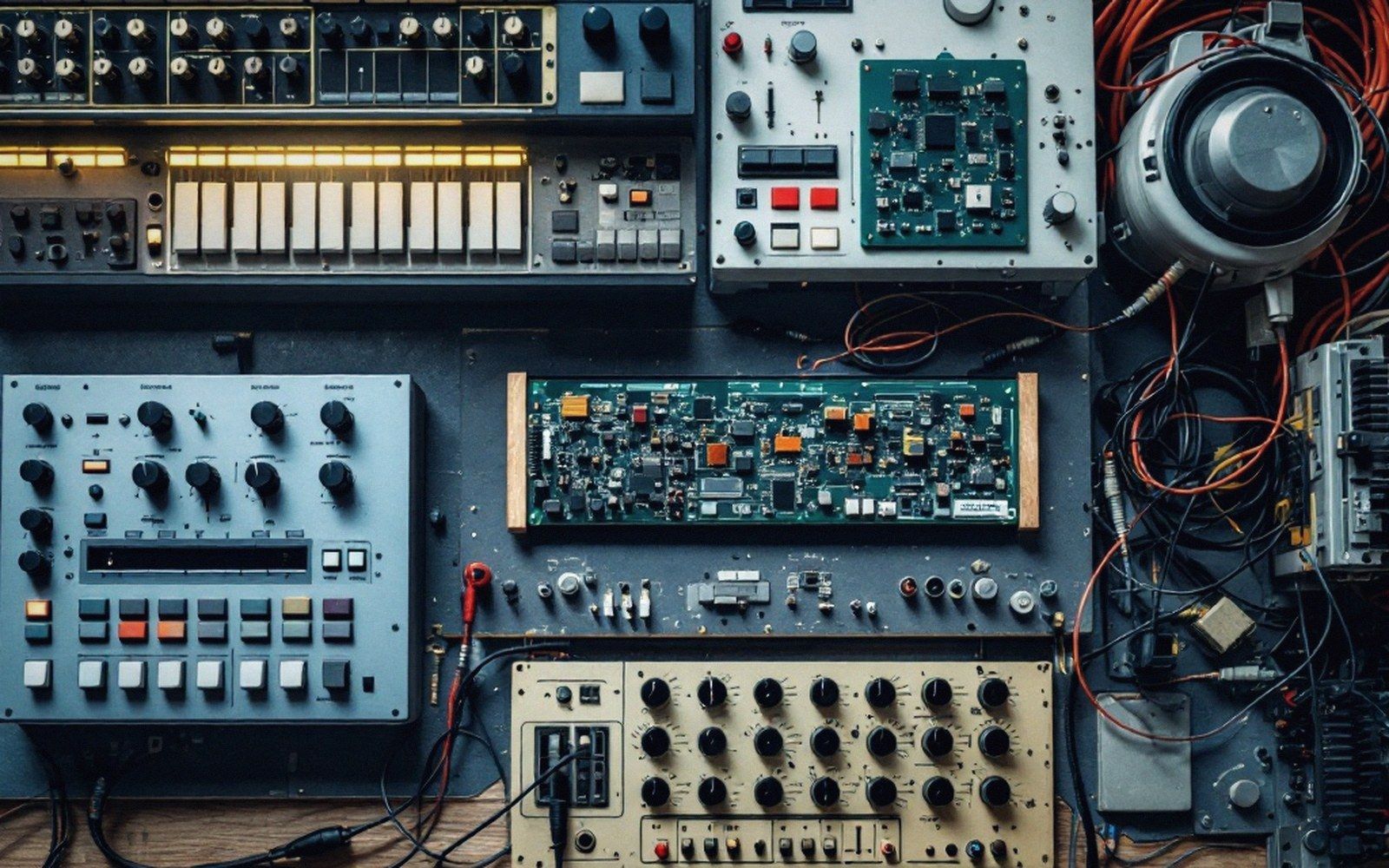
Drum machines using sampled sounds rather than synthesised ones faced the same constraint. A snare captured at twelve bits carries a characteristic texture in its ring and tail — not the clean, smooth decay of a well-recorded drum, but something spikier, with a faint underlying agitation. At high tempos and high levels in a mix, this reads not as distortion but as presence. The noise floor becomes part of the sustain character. Engineers working in the late 1980s and early 1990s were not choosing this; they were compensating for it. The grooves they built adapted to what the machines would tolerate. By the time sixteen-bit and eventually twenty-four-bit conversion became standard and affordable, an entire vocabulary of rhythm production had developed inside the constraints of twelve and sometimes eight bits. The aesthetic had been absorbed into the genre.
The retroactive appreciation of that noise floor followed a well-established pattern in electronic music: technical failure becomes signature, signature becomes sought-after, sought-after becomes replicated. Tuning drift in analogue oscillators took the same route — defect, then characteristic, then emulated deliberately. Quantisation noise arrived at the same destination by the same logic. By the late 1990s, bit-crushing — the deliberate reduction of bit depth in a digital processor — had become available as an effect. Studios and producers were paying, in some cases with expensive outboard units, to put twelve-bit or eight-bit noise back into material recorded at twenty-four. The irony is exact: the limitation that was a cost problem in 1983 became, twenty years later, a sound you paid extra to access.
Each time an incoming signal level falls between two available steps, the converter rounds to the nearest one and discards the difference.
What the emulation actually does and what it misses
Modern bit-crushers are precise. They genuinely reduce the word length of the audio and reintroduce the correct quantisation noise profile. Used carefully, they reproduce the arithmetic behaviour of a twelve-bit converter with real fidelity. What they do not fully reproduce is the rest of the signal chain that surrounded those converters in an early sampler: the anti-aliasing filters on the input, often cheap and non-linear; the output reconstruction filters, frequently crude; the analogue circuitry before and after the conversion stage, designed to a tight budget and not particularly neutral. A real Emulator II has a character that is more than its bit depth. The converter is the headline specification, but the supporting cast — input transformers, op-amp stages, filter topology — shapes the sound in ways that are harder to name and harder to replicate cleanly with a single algorithmic parameter.
- Early 1980s: twelve-bit conversion common in affordable samplers (e.g. Akai S612), with eight-bit machines such as the Mirage and Emulator alongside — cost-driven
- Mid-to-late 1980s: production practice adaptshotter levels, shorter samples, aggressive editing to manage the noise floor
- 1990s: sixteen-bit and twenty-four-bit conversion becomes affordable; quantisation noise recedes as a practical problem
- Late 1990s onward: bit-crushing appears as a deliberate effect; twelve-bit noise floor becomes an aesthetic resource rather than a constraint
This is the part that bit-depth nostalgia tends to collapse. "Twelve-bit sound" becomes a shorthand for a quality that is actually a combination of factors: the converter resolution, the analogue design choices, the sample rate, the specific filters. Separating them out matters if you are trying to understand what the machine actually did and why it sounds the way it does. The bit depth is the easiest part to measure and the easiest part to recreate; it is also, in isolation, only part of the story.
None of that diminishes the central fact. The engineers who shipped those early samplers made a decision at a component specification meeting that was fundamentally commercial: this is what the converter costs, this is the margin we need, these are the bits we can offer. They were not designing an aesthetic. They were managing a bill of materials. The people who used those machines inherited the consequences, adapted to them, and built music inside them that could not have been built any other way — not because the limitation was secretly ideal, but because limitation is always the condition in which a practice forms. Twelve bits was the number the budget allowed. The sound that came from it was real, and the decision that made it was not.