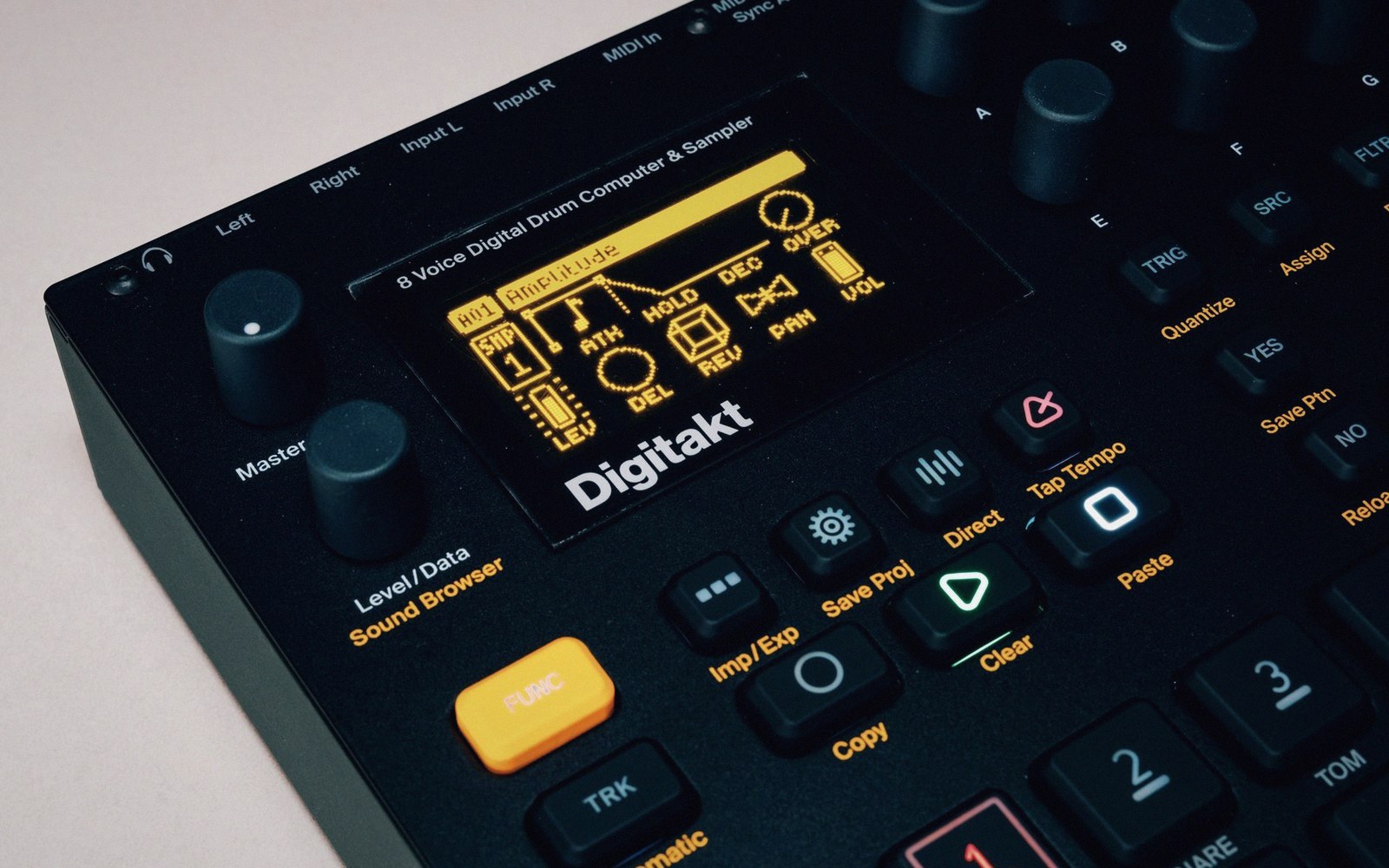
 Photo: Egor Komarov / Pexels
- The ceiling
- Pitch and duration move together or not at all
- What imposed it
- Pitching by playback rate
- What it produced
- Transposition as an audible effect, and then as a style
Early digital samplers had one way to change pitch: play the recorded audio faster or slower. There was no independent time-stretching, no formant correction, no decoupling of frequency from duration. Pitch and length were the same parameter, expressed differently. Double the playback rate and you got an octave higher; half the rate and an octave lower — and the sample lasted half or twice as long, accordingly. This was not a design oversight. It was the only affordable approach.
The mechanism is clean in principle: a sample is a sequence of numbers, and the rate at which those numbers are converted back into voltage determines the pitch you hear. The original recording rate is a neutral, zero-transpose playback. Move faster through the buffer and the waveform completes its cycles more quickly; the perceived pitch rises. Move slower and cycles spread out; pitch falls. Duration follows as a direct consequence. This is called variable-rate playback, and it governed the character of sampling through the early and mid-1980s.
- Variable-rate playbackthe buffer of recorded numbers is read out faster or slower; pitch and duration change together
- Root pitchthe note at which a sample was originally recorded; the reference point from which transposition occurs
- Multi-samplingrecording the same instrument at multiple pitches to limit the range each sample must cover; a direct consequence of variable-rate artefacts at wide intervals
- Formanta resonant peak in the frequency spectrum of a voice or acoustic instrument; does not stay fixed when playback rate changes
What the artefact sounds like
When a sample of a voice, a string or a drum hit is played back at a substantially different rate from the one at which it was recorded, several things happen at once — and none of them are neutral.
Transients shorten with raised pitch and stretch with lowered pitch. A snare hit resampled an octave up loses the crack's natural decay; an octave down, the same hit becomes a soft, lumbering thud that arrives slowly. Neither is wrong, exactly, but both are far from accurate. This is what made early samplers unusable for straightforward replication but highly useful for making something new from a recorded fragment.
Formants — the resonant peaks of an acoustic instrument or a human voice — move with playback rate. A voice sampled at middle pitch and played back an octave higher produces the classic chipmunk compression: formants shift up with the melody. Producers heard this not as failure but as texture. The Emu Emulator, the Fairlight CMI and the early Akai samplers all exhibited this quality, and tracks made on them during the first decade of commercial sampling carry it as a period marker as recognisable as tape hiss.
The further from the root pitch — the note at which the sample was recorded — the more extreme the artefact. This created a practical limit: a single sample could cover perhaps a fifth or a sixth before the result became too obviously wrong for musical use. Covering a full keyboard with realistic timbre required recording the same instrument at multiple pitches and mapping each recorded zone to a narrow range. This was a solution born entirely of the constraint. The practice of multi-sampling, which is now standard in virtual instruments, did not arrive from acoustic theory; it arrived from the misbehaviour of variable-rate playback at wide intervals.
Techniques built from the constraint
The constraint was not purely a problem to solve. Variable-rate playback gave early samplers a particular plasticity that producers learned to exploit deliberately.
- Early 1980s: commercial samplers (Emulator, Fairlight CMI) use variable-rate playback as the only available pitch method
- Mid-1980s: multi-sample mapping becomes standard practice as a workaround for audible artefacts at wide intervals
- Late 1980s onward: time-stretching algorithms begin to decouple pitch from duration, introducing different artefacts in place of the originals
Pitching a spoken word or a vocal phrase down far enough transformed it into an unrecognisable texture — something between a groan and a drone — that could be played melodically. Pitching a bass guitar loop upward by a semitone or two changed not just the pitch but the attack character and the perceived brightness in a way that no equaliser could replicate, because the formant shift went with it. The sampler was not transposing; it was transforming.
The two-and-a-half second memory ceiling imposed on early samplers meant that samples were almost always short. Variable-rate playback interacted with this limit directly: stretching a sample by dropping its pitch also lengthened its duration, which used no extra memory but ate available musical time. A one-second drum loop played a fifth below its original pitch became a one-and-a-half second drum loop. This was either a problem or a compositional fact, depending on the session.

Reverse playback — running the buffer backwards — combined with pitch change produced its own family of sounds: reversed pitched-up vocals that compressed and chirped, reversed slowed-down hits that built up in unnatural slow reverse crescendos. These were not intended features; they were the logical extension of the same playback-rate mechanics, and they became part of the vocabulary for the same reason the original artefacts did: they sounded like nothing else.
The artefact and the technique were never fully separable. What variable-rate playback produced was a sampler that did not simply reproduce the world but bent it in a consistent, predictable direction — and predictable bending, once understood, becomes a tool. The machines that came after, with their time-stretching algorithms and formant correction, solved the original problem and introduced new ones. The sound of their solutions is different, and no better or worse — just later.