 Photo: S J / Pexels
- The ceiling
- What could be loaded, not what was owned
- What imposed it
- Disk capacity and load time
- What it produced
- Sessions built from the ten sounds within reach
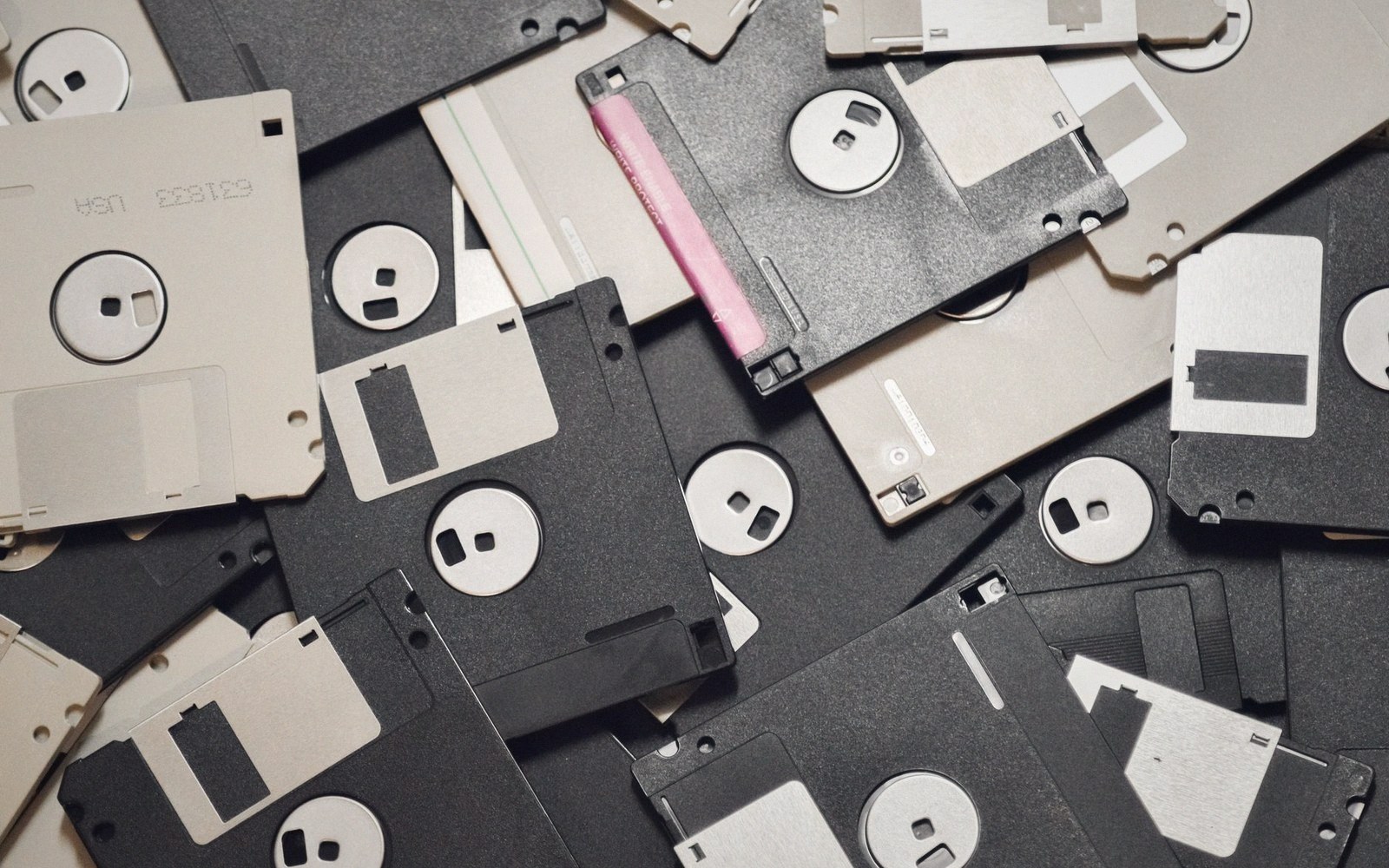
Before samples lived on a hard drive — before they lived in RAM that survived a power cycle — they lived on floppy disks, and the session lived around them.
The early samplers that defined a generation of records, machines like the Akai S900 and the E-mu Emulator II, operated on a model that feels almost ceremonial now: you loaded a sound from disk into RAM, played it, then decided whether to keep it resident or swap in something else. RAM was scarce enough — often measured in single-digit megabytes — that a full kit could not always coexist with a bass patch and a string layer simultaneously. Something had to come out for something else to go in.
The floppy disk was not background infrastructure. It was the instrument's memory, physically handled. A session library might be two dozen disks spread across a keyboard lid, each one labelled in marker pen, each one representing a decision: this sound, not that one, because both won't fit. Producers working on the MPC60 or the Akai S1000 in the late 1980s and early 1990s understood disk cataloguing as a compositional skill on par with tuning.
- Late 1980s3.5-inch double-density and high-density floppies standard on samplers including the Akai S900, S1000
- Early 1990sAkai, E-mu and Roland begin shipping SCSI ports; external hard drives become practical but expensive
- Mid-1990sIomega ZIP disk (100 MB) starts to displace floppy as primary session storage for sampler users
- Late 1990sCD-ROM sample libraries dominate; floppy use declines sharply
The Load Time Was Part of the Workflow
A 3.5-inch high-density disk held 1.44 megabytes. Loading it through a floppy drive running at standard speed took between fifteen seconds and a minute, depending on the machine and the size of the patch. In a commercial studio, that was billed time. The load screen was not idle; it was the moment to check a note, change a setting, rethink a section.
This friction shaped arrangement in ways that are hard to unwind from aesthetics. Because swapping a drum patch mid-session was expensive in time and concentration, producers tended to commit early and build around what was already resident. The constraint produced focus: if the snare was loaded and it was the right snare, you found a way to make it right rather than hunting for something marginally better on disk fourteen. The twelve-bit argument — that a technical limitation became a sound — applies here at the level of workflow rather than signal. The sound of early sampler records is partly the sound of not being able to change your mind easily.
The Discipline of the Catalog
Managing a floppy library required a system. Commercial sample libraries sold in the early 1990s — the Akai CD-ROM and floppy series, Prosonus, Zero-G — came in coordinated sets designed to keep related sounds on adjacent disks, so a producer building a kit could load kick on disk one and snare on disk two without cross-searching. The physical organisation of these libraries was a form of pre-editing: the company had decided which sounds belonged together before the producer ever touched the session.
That pre-editing had consequences. Producers working from commercial libraries often shared the same core sounds not because they copied each other but because the disk-based library was the common infrastructure. The same Rhodes patch, loaded from the same floppy, appeared across dozens of records in the same year. Storage scarcity produced a kind of involuntary sonic palette — shared not by choice but by the shape of what was available and loadable in time.
When hard drives and ZIP disks made it practical to hold hundreds of sounds resident at once, the floppy's discipline dissolved. The gain was obvious. But the catalogue mentality — the habit of deciding before the session what sounds were worth loading, and therefore what the record would be built from — went with it, and the sessions that followed were not always better for the freedom.
- Akai S900 RAM750 KB base, expandable to 2.5 MB
- Akai S1000 RAM2 MB base, expandable to 32 MB
- E-mu Emulator II512 KB RAM, 5.25-inch floppy as primary storage
- MPC60750 KB RAM standard; floppy for all patch and sequence save/load
- 3.5-inch HD floppy — 1.44 MB capacity, approximately 15–60 second load time depending on patch size and machine