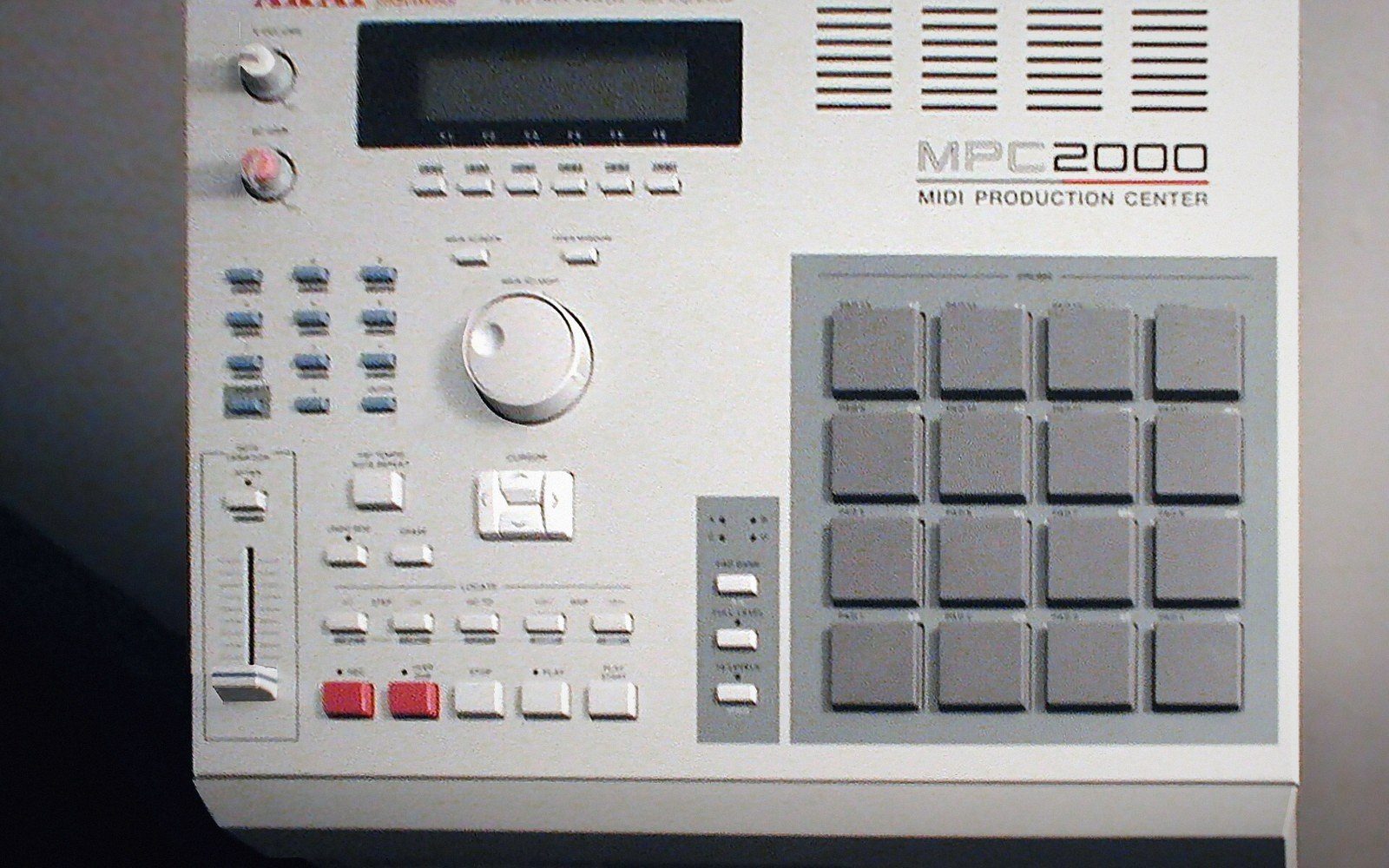
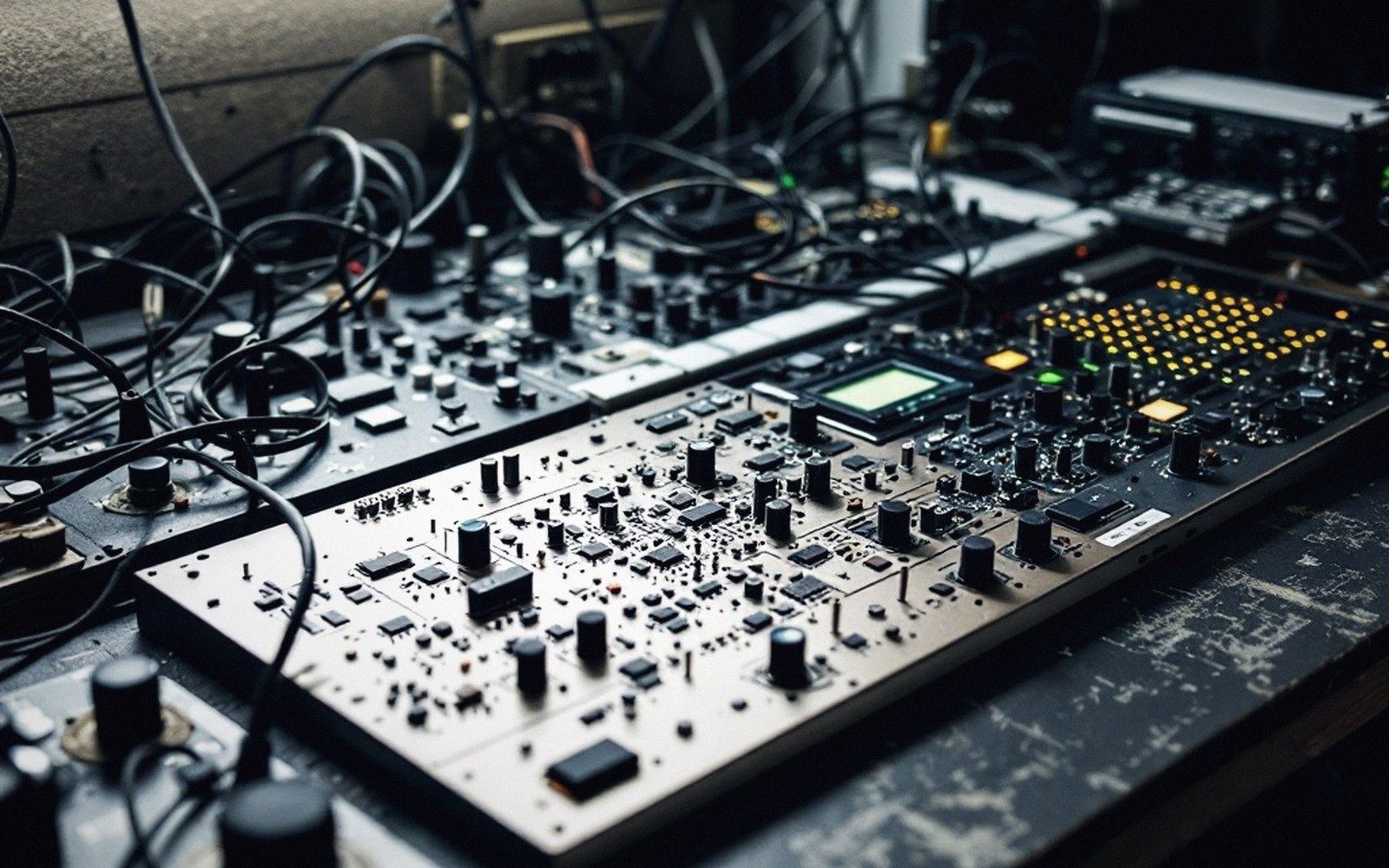
 Photo: Akai MPC2000 (front).jpg · Wikimedia Commons
The Memory Ran Out, So the Break Was Cut Into Pieces
When the ceiling is set by the cost of RAM, not by a musical idea
- The ceiling
- Two and a half seconds of hold time
- What imposed it
- The price of memory, not anyone’s idea of a technique
- What it produced
- The recorded bar treated as raw stock, cut into pieces
Early samplers did not invite you to record a performance. They invited you to record a piece of one. The limit was stated plainly in the specification — two seconds, two and a half, occasionally four if you paid more — and that number was not a musical judgment. It was the price of RAM in the early 1980s converted directly into time. A kilobyte of memory held a fraction of a second of audio, and kilobytes were expensive enough to count. The ceiling was financial before it was aesthetic, and it became aesthetic only because musicians hit it and kept going anyway.
The Mellotron had already proved that a short tape loop could be a usable instrument, but the loop was locked to its tape strip and its pitch was fixed by playback speed. What changed with the digital sampler was that the fragment became malleable: you could repitch it, trigger it from anywhere on a keyboard, layer it, and play it in an order no one had recorded. The constraint remained — duration — but what you could do inside that duration multiplied enormously. Two and a half seconds of drum audio, handled right, turned out to be sufficient raw stock for a new kind of composition.
- E-mu Emulator (1981)sample time measured in fractions of a second per key
- Ensoniq Mirage (1985)approximately 1–2 seconds total sample time at default rate
- Emu SP-1200approximately 2.5 seconds total across all pads, at 26.04 kHz
- Akai S900limited total RAM; professional standard, still tightly constrained
- Akai S1000 (1988)significantly expanded memory; marked the turn toward longer capture times
The arithmetic of RAM and what it produced
The E-mu Emulator, released in 1981, gave each key a sample time measured in fractions of a second. The Ensoniq Mirage, which arrived in 1984 at a price point that put sampling within reach of working musicians for the first time, offered around a second of sample time at its default sampling rate — stretched to two seconds if you dropped the rate and accepted the bandwidth loss. The Akai S612 and then the S900 incrementally pushed the ceiling upward, but even the S900, considered a professional instrument, offered total sample memory that seems absurd now. You were always choosing what to keep and what to cut.
The choice forced attention. If you had two seconds to work with, you listened very carefully to which two seconds mattered most. A drummer playing a full bar at 100 beats per minute occupies roughly 2.4 seconds — close enough to the limit that the decision of where to start and stop the sample became compositional in itself. Cut half a beat early and the sample breathes differently when it loops. Include the decay of the snare or truncate it? Leave the room noise at the tail, or fade it abruptly? Every edit was an argument about what the sound actually was. The machine's constraint turned the engineer into an editor and the editor into something closer to a composer.
This is the mechanic behind what became known as the breakbeat — the isolated percussion passage, usually from a funk or soul record, stripped away from the song around it and looped. The break was already a musical event in the original record, the moment when the band dropped out and the drums carried the track alone. Hip-hop DJs had been isolating those passages manually since the mid-1970s, using two copies of the same record on paired turntables. The digital sampler did not invent the break; it just made the isolation permanent and the manipulation precise. When Marley Marl, working in New York in the mid-1980s, began triggering individual drum hits from a sampler rather than looping a full bar, he was exploiting exactly the logic the memory ceiling had enforced: small pieces, used individually, could be reassembled into a pattern that never existed in the original recording.
The break was already a musical event in the original record, the moment when the band dropped out and the drums carried the track alone.
The fragment as composition
What the memory limit accidentally produced was a grammar of fragments. Once a bar was too long to hold in one piece, the natural response was to hold it in several. A kick drum hit, a snare hit, a hi-hat decay — each loaded separately, each occupying its modest allocation of RAM, and together constituting a kit that existed only in the machine's volatile memory and in the sequence the producer had programmed. The original drummer had played them in one continuous performance. The sampler disaggregated that performance into components and handed them to whoever was sitting at the sequencer.
- Breakthe isolated percussion passage in a funk or soul record; the bar where the band drops out
- Chopdividing a recorded bar into individual hits for independent triggering
- Retriggeringplaying sampled hits as sequencer events rather than as a continuous loop
- Room tonethe acoustic consistency across a live drum performance that disaggregation destroys
The sonic consequences were significant. A drummer's kit has consistent room tone across every hit — the same air, the same microphone placement, the same performance energy binding each stroke to the next. When the sampler broke those strokes into separate samples and retriggered them as sequencer events, the room tone fragmented too. Each hit could be pitched independently, processed independently, placed at any dynamic level the programmer chose. The resulting texture was not a drummer in a room. It was a construction built from pieces of a drummer in a room, and it sounded like that: slightly uncanny, hyper-precise in its placement, the decay of each hit sometimes cut short by the next trigger. That specific texture — tight, chopped, reassembled — became the sound of a decade.
Producers working with the twelve-bit limitations of early digital conversion found that the memory ceiling and the bit-depth ceiling operated together. Low sample rates kept memory consumption down but introduced aliases and bandwidth roll-off that coloured the sound in ways that proved, retrospectively, distinctive. The gritty, slightly blurred quality of a break sampled at 26 kHz on an Akai S900 is not a neutral transcription of the source material. It is the source material filtered through the economics of 1987, and that filtering became part of what people were listening for.
The Emu SP-1200 made the relationship between memory and time almost brutally clear: approximately 10 seconds of total sample memory (2.5 seconds per bank), at a sampling rate of 26.04 kHz. Producers using it for hip-hop and early house music learned to work in that space with extraordinary efficiency. A loop that would not fit was simply cut shorter, pitched up slightly to compress its duration, or — in the case of the SP-1200's famous workflow — chopped into single hits and sequenced. The machine did not explain any of this. The constraint did.
After the ceiling lifted
When memory prices fell through the late 1980s and into the 1990s, samplers acquired seconds, then tens of seconds, eventually minutes of storage. The Akai S1000, released in 1988, represented a genuine step change in available memory. The S3000 series pushed further. By the time hard-disk recording and then software samplers arrived, duration ceased to be a meaningful constraint at all. You could hold the whole performance.
And yet the grammar of fragments persisted — not because anyone was forced to use it, but because it had become a way of hearing. Producers who had learned composition by carving a bar into eight pieces continued to think in pieces. The chop became a stylistic choice rather than a technical necessity. What the memory ceiling had enforced, taste then preserved. The constraint was original; the aesthetic that followed was chosen. Whether that distinction matters musically is arguable, but it matters historically, because it locates the technique: not in an idea someone had, but in a number that RAM manufacturers set, a price that held for about a decade, and the sound that came out of working within it.