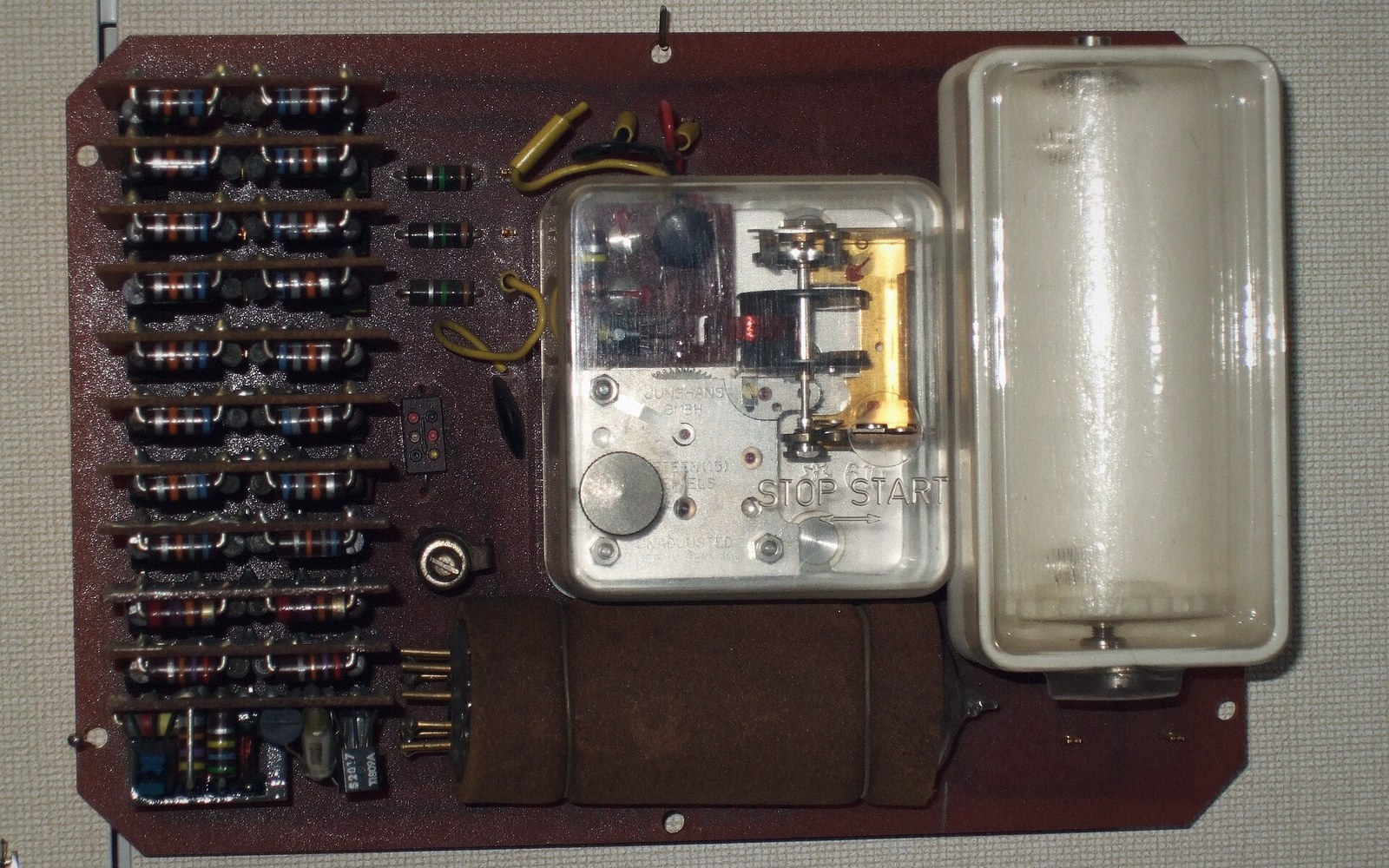
 Photo: Versuchsmodell Quaruhr Karl Gebhardt.jpg · Wikimedia Commons
- The ceiling
- Pitch will not stay where you put it
- What imposed it
- Analogue oscillators moving with the temperature of the room
- What it produced
- Drift heard as warmth — engineered out, then bought back
Analogue oscillators are voltage-controlled, and voltage depends on temperature. That chain of dependency means an oscillator left to warm up for the first twenty minutes of a session drifts measurably in pitch — and even a fully warm instrument wanders, subtly, with every passing degree of room temperature and every fluctuation in the power supply. On the early Minimoog and on the ARP 2600, holding a single note for long enough revealed a living, slightly unsteady thing where a fixed frequency was supposed to be.
This was understood as a defect. Manufacturers spent real engineering effort on temperature compensation: circuits designed to counteract the drift coefficient of whatever transistors or capacitor-resistor networks sat at the heart of the oscillator. Early VCOs built around discrete transistors were worse offenders than later designs; when Curtis and SSM began supplying dedicated oscillator chips in the mid-1970s, stability improved as a direct consequence of tighter manufacturing tolerances and better thermal coupling between matched components. The promise was accuracy. The result was that something also disappeared.
What drifting oscillators had been doing, quietly, was thickening sound. The classic technique of stacking two or three oscillators slightly detuned against each other — heard on almost every Minimoog patch that ever made it to tape — relies on a similar principle: when two sources tuned close to the same pitch interact, they produce amplitude modulation at the difference frequency, and the result is a slow beating that gives the sound breadth and motion. Intentional detuning is a controlled version of what drift was doing accidentally. Players who had worked with unstable instruments already understood that tiny pitch variations between voices produced an organic quality that precisely tuned oscillators did not.
- Mid-1970sCurtis and SSM oscillator chips improve VCO stability through better component matching
- Oberheim Four Voice, Prophet-5 early revisionsmulti-voice drift becomes audible as a quality
- Prophet-5 revision 3.3auto-tune routine standardises oscillator pitch across voice cards
- Roland Juno-6single oscillator per voice; built-in chorus circuit recovers perceived width
When stability became the problem
Polyphonic synthesisers sharpened the question. Instruments like the Oberheim Four Voice and the early Prophet-5 packed multiple voice cards into a single chassis, and the interaction between oscillators across those cards — each one drifting at its own rate and in its own direction — produced a quality that engineers found embarrassing and users increasingly found essential. Sequential Circuits addressed this in the Prophet-5 with an auto-tune routine: a microprocessor measured each oscillator against a reference and stored correction voltages. Suddenly each note in a chord sat in its own exact place, and players who had bought earlier revisions of the instrument noted that something had been exchanged for the stability. The revision 3.3 boards are still discussed in those terms today.

What drift had been producing was, in effect, chorus — not the effect-unit version, but the genuine acoustic phenomenon of slightly misaligned sources heard simultaneously. A string ensemble sounds like a string ensemble rather than one amplified violin precisely because sixty bows are never perfectly in phase. Analogue instability replicated this without requesting it.
The formal resolution was the chorus effect unit, which applies deliberate pitch modulation to a signal to recover something of the warmth that transistor-level precision had removed. The Roland Juno series used a built-in chorus as a partial substitute for multi-oscillator architecture; the Juno-6 had a single oscillator per voice and leaned on that chorus circuit to supply width. The effect unit was engineering the instability back in by a different route, but as a parameter now — a rate control, a depth control, something that could be switched off and measured. The original drift had no switch.
A string ensemble sounds like a string ensemble rather than one amplified violin precisely because sixty bows are never perfectly in phase.
This is not a story about analogue being better. Digital oscillators are stable to a degree no VCO with temperature-sensitive components can match, and stability unlocks its own capabilities: complex FM relationships, the precise beating of two operators detuned against each other, the ability to tune a chord and leave it. But the history of what drift accidentally contributed — and then the history of engineers rebuilding drift-like behaviour into instruments as a feature rather than tolerating it as a flaw — is a clean illustration of a recurring pattern in this equipment. A constraint produces a character. The character becomes desirable. The removal of the constraint requires new engineering to approximate what was lost.
- VCO driftvoltage-controlled oscillators change pitch as temperature changes; cause is the temperature coefficient of transistors and passive components
- Beatingamplitude modulation produced when two close-pitched sources interact; the rate equals the frequency difference
- Temperature compensationcircuit technique that applies a counter-varying voltage to reduce drift across a temperature range
- Auto-tunemicroprocessor-driven calibration routine measuring and correcting each oscillator against a reference pitch