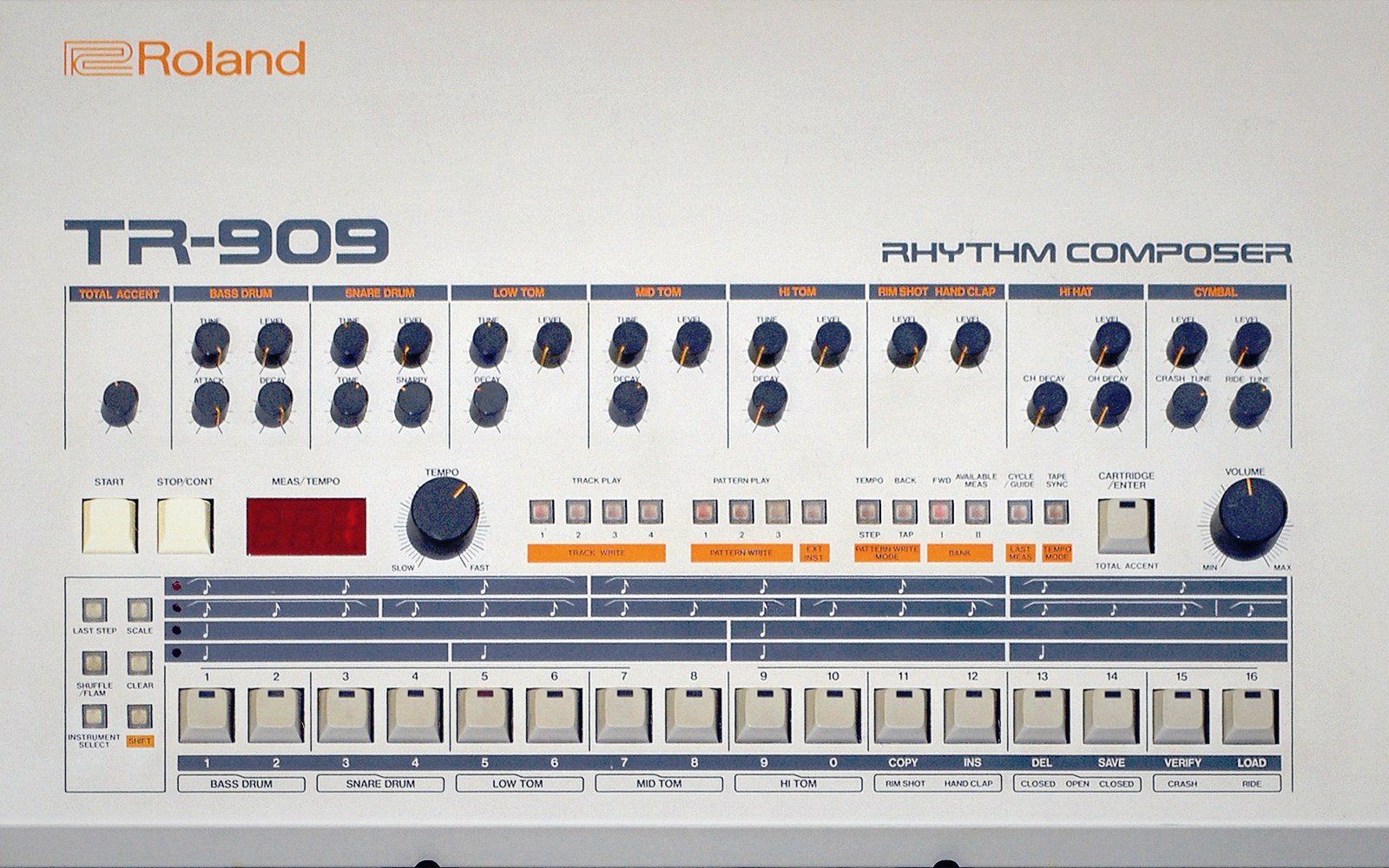
 Photo: Roland TR-909 (large).png · Wikimedia Commons
The Machine Nobody Wanted
How the Roland TR-808 failed commercially and became the sound of a century
- The ceiling
- It could not sound like a drum kit
- What imposed it
- Analogue voices sold as a demo tool and judged unrealistic
- What it produced
- A discontinued failure, bought second-hand and made canon
Roland introduced the TR-808 Rhythm Composer in 1980. It was meant to help songwriters sketch ideas without booking a session drummer, to let demo tapes arrive with something steady underneath. It cost around the same as a decent microphone preamp, ran on internal memory that held patterns, and had a row of buttons and a set of knobs that any musician could learn in an afternoon. By 1983 it was discontinued. Roland had moved on to the TR-909, to more capable machines, to the future. The 808 was done.
Then it became the sound of the twentieth century.
- 1980 — Roland TR-808 introduced; Linn LM-1 released the same year
- 1980 — Afrika Bambaataa begins working with the machine; "Planet Rock" recorded 1982
- 1982 — Marvin Gaye's "Sexual Healing" released, built on an 808 pattern
- 1983 — TR-808 discontinued by Roland; secondhand units enter the market cheaply
- Late 1990s–2000s — Atlanta trap production adopts the 808 kick as a defining bass voice
What the 808 actually was
The TR-808 produced its sounds entirely from analogue circuitry — no samples, no recordings, no reference to any real drum ever struck in a room. Every voice was an electronic description of what a drum might be: a tuned oscillator for the kick, noise filtered and shaped for the snare, differently filtered noise for the hi-hats, a handful of tone-based voices for claves, cowbell, rimshot. Analogue drum voices are not recordings of drums; they are electronic approximations built from the components available and the decisions made about which acoustic properties to prioritise. Roland prioritised something controllable and clean — and in the process built something that didn't sound like any instrument you'd heard before.
The kick drum is the 808's defining voice. It begins with a bridged-T oscillator circuit producing a sine-like tone that sweeps downward steeply from an initial pitch — the characteristic deep thud with a long, controllable decay. The Tone knob varies the texture from pure to slightly buzzy; the Decay knob extends the tail from a short punch to a sustained bass note that could underpin an arrangement on its own. This was, functionally, a tunable bass instrument that happened to be shaped like a kick drum hit. Nobody had planned it that way.
The snare works similarly: a noise burst shaped by an envelope, mixed with two tuned oscillators to give it a tonal centre. The result has little of the crack and spray of a real snare struck with a stick — it sounds more like a synthesised impact, mid-frequency and smooth. The hi-hats take a different approach: six square waves at specific, carefully chosen frequencies mixed together to produce metallic noise, then filtered differently for open and closed positions. The cowbell and claves are almost comically synthetic, short tonal blips that no one ever mistook for their acoustic equivalents.
What Roland sold in 1980 was, by the standards of professional drummers and studio engineers, unconvincing. A machine that was meant to simulate drums should at least sound like drums. The 808 plainly did not.
The reasons it failed
Roland had built the 808 partly around a batch of transistors that turned out to be faulty — not dangerously, but differently. The transistors introduced slight variations in the circuits that gave the machine some of its characteristic irregularity. More practically, the machine arrived just as drum machines from other manufacturers were moving toward sampled sounds, toward actual recordings of actual kits. Linn Electronics released the LM-1 Drum Computer in 1980, the same year as the 808, for a much higher price — but it used sampled sounds, and it sounded like a real drummer in a way that the 808 simply never could. When professional studios and session musicians compared the two, the verdict was quick.
The 808 also required its users to program patterns using a step sequencer: sixteen steps was a hardware fact before it was a musical convention, and the 808's thirty-two step maximum was enough for most popular music but felt mechanical to players who thought in terms of live feel. There was no velocity sensitivity. Every hit was the same force unless you used the accent function, which added a fixed boost to selected steps. Real drummers don't do that.
By 1983 Roland had produced somewhere around twelve thousand units. It wasn't a catastrophic run — Roland kept the lights on — but the 808 didn't sell through retail the way Roland had intended. New units began to appear at drastically reduced prices to clear stock. Secondhand 808s entered the market for even less. In Chicago and New York and Detroit, musicians with small budgets and large ideas started picking them up.
- Kick drumbridged-T oscillator, sweeping sine-like tone, controllable Tone and Decay knobs; tunable to a key
- Snarenoise burst shaped by envelope, mixed with two tuned oscillators
- Hi-hatssix square waves at specific frequencies mixed for metallic noise, filtered differently for open/closed
- Handclapfiltered noise, sharp attack; distinctive in a mix without cluttering low frequencies
- Cowbell / clavesshort tonal oscillator blips; no pretence of acoustic realism
Who bought what nobody wanted
The story of the 808's second life is, at bottom, a story about price. When the machine became cheap, it became available to people who were not professional studio operators but were professional listeners: kids who had grown up in the era of disco and funk, who had heard the relationship between a kick drum and a bass line as a structural thing, who understood rhythm as an argument between low frequencies. The 808's kick drum, with its long tunable decay, sat in almost the same register as a bass guitar or a synthesiser bass. You could tune it to the key of a track. You could make it sustain underneath an arrangement and have it function as harmonic content as much as percussion.
In Atlanta, Miami, Houston, New York, Chicago — across American cities with strong traditions of Black popular music and limited access to expensive studio infrastructure — the 808 became a production tool precisely because it was cheap, portable, and programmable. It was the drum machine equivalent of the Fender Precision Bass or any other tool that changed hands when its original market moved on and a new one picked it up. Afrika Bambaataa's 1982 track "Planet Rock," produced with Arthur Baker and John Robie, used the 808 openly and loudly, the kick and the handclap recognisable to anyone who knew the machine. It wasn't trying to sound like a studio recording. It was trying to sound like something new.
What followed from that moment is a matter of historical record. Hip-hop production through the mid-to-late 1980s relied on the 808 heavily, particularly for its handclap — that snap of filtered noise that cuts through a mix without muddying the low end — and for its bass drum, which could hold a groove at the bottom of a track in a way that made drum kit emulation feel beside the point. Marvin Gaye's "Sexual Healing" in 1982 ran on an 808. Early electro records were built around it. Miami bass, the Atlanta trap production that emerged in the late 1990s and dominated the 2000s and 2010s, the entire trajectory of hip-hop's relationship with sub-bass — all of it runs through that twelve-thousand-unit commercial disappointment.
Why the failure was the condition
It is worth being precise about why the 808 became what it became, because the commercial failure was not incidental to the aesthetic outcome — it was constitutive of it. If the 808 had sold well, its prices would have remained high, it would have stayed in professional studios, and it would have been used by professional musicians trying to replicate existing production norms. The whole gravitational pull of professional studio use is toward sounding like records that already exist.
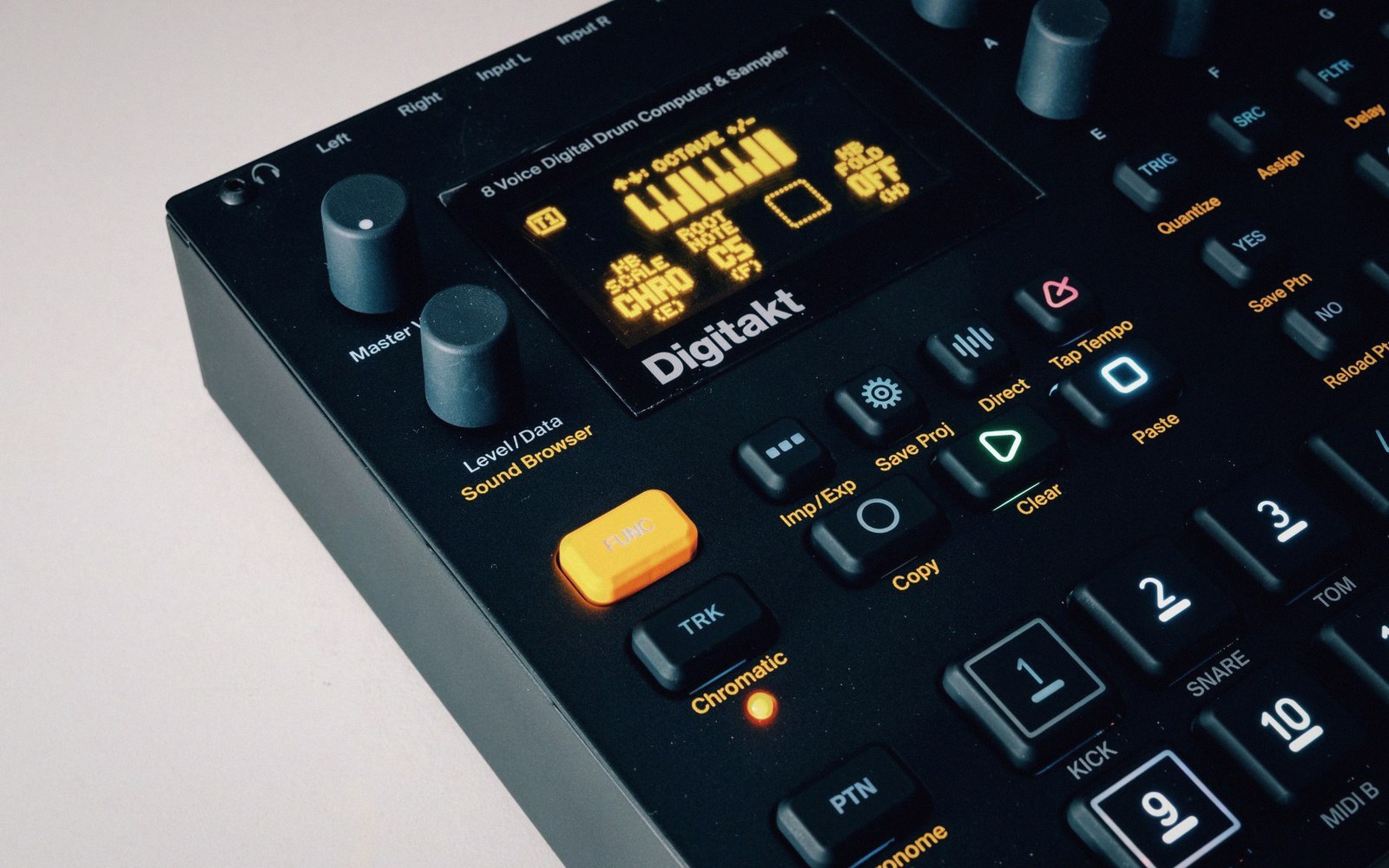
The machine's limitations reinforced this. Sixteen steps per bar at the default resolution, a small but expressive accent system, a fixed set of voices that could be tweaked but not replaced — these constraints made the 808's patterns sound like 808 patterns, recognisable and repeatable. Producers learned the vocabulary of the machine, then made that vocabulary the sound. The kick was not a substitute for a kick drum; it was an 808 kick drum, a specific thing with a specific character that belonged to specific music.
The step sequencer's feel, the voice architecture's refusal to pretend, the price that sent the machine sideways through the economy of American music — together these produced a canon. Roland tried to make a studio utility and made instead one of the most copied, emulated, sampled and re-released sounds in popular music history. Every subsequent Roland product called "808" is a tribute to the failure of the original. Every drum machine that followed had to position itself against it.
The TR-808 was nobody's first choice in 1980. That's exactly why it matters.