 Photo: Egor Komarov / Pexels
- The ceiling
- Feel reduced to two numeric settings
- What imposed it
- Shuffle and accent implemented as global amounts
- What it produced
- Programmed groove — audibly not played, and used that way on purpose
There is something strange about opening a drum machine manual and reading the word "feel" next to a percentage. Swing is not an idea invented by machines — it predates them by decades, rooted in the gap a jazz drummer holds between the ride cymbal's downbeat emphasis and the way the snare leans back just enough. What the drum machine did was ask: how much of that gap do you want, and can you enter it as a value?
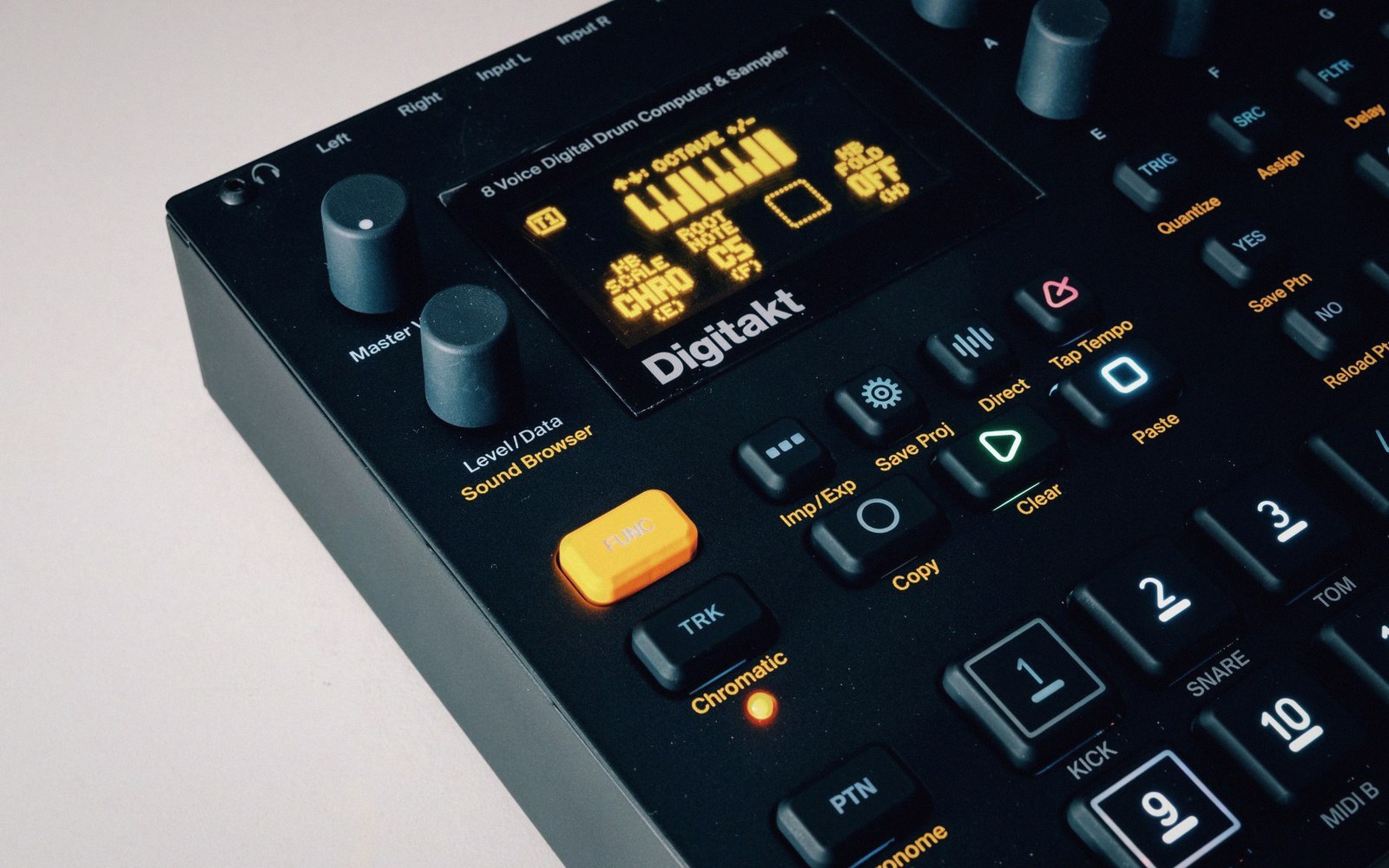
The Roland TR-909 answered that question directly. Its shuffle function — often called swing — delayed every second sixteenth note in a pattern by a variable amount, pushing it fractionally behind the strict grid. At zero, the pattern was metronomic. Turned up, the even subdivision became uneven in a consistent, repeatable way. The mechanism was simple: a timing offset, applied uniformly to every alternating step. The result was a groove that sat somewhere between mathematics and feel, its exact character depending on how far you nudged the control and, critically, at what tempo you were running.
- Swing as a ratio— a timing delay that changes in musical effect depending on BPM; same percentage, different feel at different tempos
Tempo matters because a swing delay is often a fixed amount of time, not a fixed proportion of the beat. A delay of ten milliseconds at 100 BPM is a different rhythmic experience from ten milliseconds at 140 BPM. The faster the tempo, the smaller the delay is relative to the beat, and the subtler the effect. This is why the same swing percentage setting sounds lazy and obvious at slow tempos and almost imperceptible at fast ones — the parameter is fixed but the musical effect is not. Producers working with machines that expressed swing as a percentage were, whether they knew it or not, working with a variable whose feel changed with context.
The 909's shuffle has been among the most-studied parameters in electronic rhythm. House and early techno producers found that its sweet spot — generally somewhere in the upper-middle range of the control's travel — created a forward momentum that strict quantisation couldn't supply. The sixteenth-note hihat patterns that define four-four house music depend on this offset: without it, they clatter mechanically; with the right amount, they breathe. The step programming that produced these patterns was combined with swing to create something that felt, from the dance floor, less like a program and more like an intention.
Accent as Dynamics by Other Means
Swing addresses timing. Accent addresses volume — or rather, what happens when a drum machine's fixed velocity gets a single controllable override. In the 808 and 909, accent was a per-step decision: you could flag any step as accented, and the accent control set how much louder those steps would hit relative to the un-accented ones. This gave the pattern two velocity layers instead of one, which is a severe constraint compared to a drummer — but a drummer doesn't produce exactly the same accent at 120 BPM on every repetition of a pattern for an hour.
The musical logic of accent maps onto the physical logic of what a drummer actually emphasises. The one, the three, the snare backbeat, the syncopation that needs to pop above the grid — these are the notes that get flagged. Used badly, it just makes certain hits louder in a way that sounds mechanical rather than expressive. The difference is the same as it is with swing: understanding what the parameter models and what it ignores.
What accent ignores is everything between the two levels. Acoustic drumming has enormous dynamic range and an essentially continuous velocity spectrum. Accent on an 808-era machine compresses that to binary: this step is louder, that step is not. The result has a specific character — decisive, punchy, almost declarative — that engineers learned to work with rather than around. The accent on a bass drum isn't trying to reproduce the nuance of a brushed stroke; it's trying to produce emphasis, and emphasis is something two velocity levels can do.
- 808/909 accent architecture — per-step flag plus a single global level control; result is binary dynamics (normal / accented), not a velocity continuum
- Context: acoustic drums operate across a near-continuous dynamic spectrum; drum machine accent deliberately collapses this into a design decision
The Gap Between Programmed and Played
Where swing and accent together become interesting is the point where they start to close — only slightly, never fully — the gap between a programmed pattern and a performed one. Neither parameter is a simulation of a human player. They are abstractions of specific properties that playing has: uneven subdivision, dynamic variation. By modelling these properties at the level of the machine's architecture, they produce something that isn't playing but isn't pure mechanism either.
That middle ground is where a large amount of electronic music actually lives. The tuning drift in an analogue oscillator, the transient character of a circuit approximating a snare — these are cases where constraint and imprecision become signatures. Swing and accent work differently: they are deliberate parameters, consciously set, not accidental artefacts. But they share the same structural logic. A limitation — fixed velocity, rigid grid — gets a partial correction. The partial correction doesn't remove the machine's character; it inflects it. The drum machine still sounds like a drum machine. It just sounds like one that is leaning into the beat.