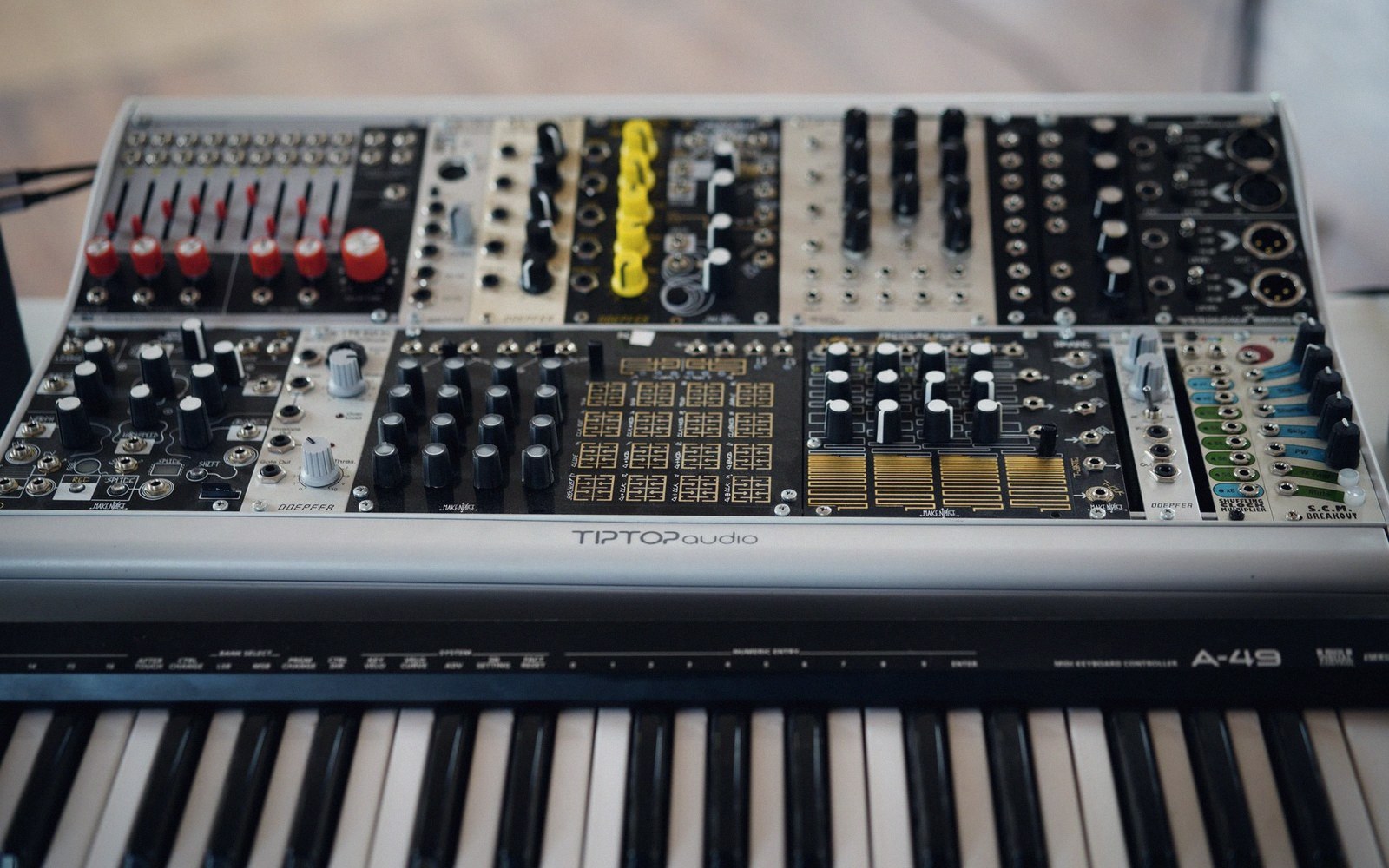
 Photo: generated
- The ceiling
- Three operations, and no waveform to look at
- What imposed it
- No display to edit against and no processing to spare
- What it produced
- Years of records made from exactly those three
Early samplers gave you a recording and three things you could do to it. Truncate: decide where it starts and ends. Loop: play a section repeatedly so a sound sustains beyond what the original captured. Reverse: play the recording backwards. That was the vocabulary, and from roughly 1980 to the early 1990s, an enormous proportion of recorded music was made entirely within it.
The limits were not rhetorical. They were the direct result of what memory cost and what processors could handle. A few seconds of audio at anything resembling acceptable fidelity consumed hardware that had to be priced into a product someone might actually buy, which meant every operation on that audio had to be achievable without additional computation overhead. Truncate is essentially free — it just redefines the start and end pointers into a memory buffer. Loop adds a conditional branch: when the playhead reaches the loop end point, jump back to the loop start. Reverse re-reads the same buffer in the opposite direction. None of these operations require the sample to be recalculated or rewritten. They are instructions about how to navigate data that already exists. Constraint as engineering logic, not aesthetic programme.
- Truncateredefines start and end pointers in the memory buffer; computationally free; places the transient in time
- Loopa conditional branch: at the loop-end point, jump to the loop-start point; solved the RAM/sustain problem; quality determined by point placement
- Reversereads the existing buffer backwards; no recalculation required; produces rise-then-decay, the attack an acoustic instrument cannot make
What each operation actually does
Truncation is the edit, and almost nothing in sampling history escapes it. A drum break recorded to give the sampler something to work with contains the room, the count-in, the bleed, the decay tail. Truncate strips all of that down to the hit — or, crucially, to a loop of the hits. Exactly what you could fit into memory decided what counted as a sound. Truncation defined the attack. It defined the groove, because where you placed the start point changed the feel of the transient against the clock.
Looping solved a practical problem: a piano note, held, lasts longer than any affordable amount of sample RAM. A skilled engineer would find a stable cycle within the sustain — a few hundred milliseconds where the waveform repeats convincingly — and loop it, smoothing the join so the ear doesn't register the seam. Done badly, a loop clicks or wobbles; done well, it extends a one-second recording into an instrument that can hold notes indefinitely. The art was entirely in finding the loop point. On hardware where you set points by ear, with little or no display to guide you, this was painstaking work. It was also where the sample came alive or died.
Reverse is the operation that most obviously escaped utility and became aesthetic. Playing a recording backwards produces the one thing an acoustic instrument cannot: an attack with no initial transient, rising rather than decaying, with the room information arriving before the note. It sounds wrong in a way that is immediately distinctive. Reversed cymbal swells, reversed guitar notes used as pre-echo, reversed vocal textures beneath a mix — these were period markers partly because they were easy and partly because they sounded like nothing except the machine doing the operation.
A drum break recorded to give the sampler something to work with contains the room, the count-in, the bleed, the decay tail.
The music the vocabulary made
What is striking in retrospect is how little more was needed. Hip-hop production built its rhythmic identity on truncated drum breaks — the attack trimmed to a decision, the decay cut entirely, each hit starting precisely where the producer wanted it to start. Ambient and electronic producers used loop points to transform short string or choir recordings into sustaining textures. Reverse gave pop records their transitional moments throughout the 1980s. These are not applications that exhaust the possibilities of the operations; they are applications that discovered what the operations were for.
- None of the three operations require the audio to be rewritten or recalculated — they navigate existing data
- Memory cost and processor limits made additional operations impractical; these three were the ones engineering allowed
- Transparency of result: changes are immediate and concrete, enabling fast iterative work
Later samplers added timestretching, pitch-shifting independent of speed, and real-time granular processing. Each of these required genuine computation. Each opened new territory. But they also introduced choices, and choices introduce a kind of friction that is absent from truncate, loop, reverse. Those three operations have almost no creative overhead: you hear what you did immediately, in terms that are entirely concrete. The start point is earlier or later. The loop clicks or it doesn't. The thing plays backwards. The vocabulary was small enough that the instrument's logic was transparent, and that transparency — as much as any particular sound — is what let people work fast enough to think with the machine rather than at it.