 Photo: Alena Sharkova / Pexels
- The ceiling
- A programmer’s interface asked to be performed
- What imposed it
- Step entry as the machine’s native mode
- What it produced
- Playing the sequencer instead of writing into it
Step programming is composition in miniature — each of the sixteen buttons a decision made before the music starts. But the pad grid turned the sequencer into something closer to a keyboard, a surface you play in real time rather than set in advance. The instrument didn't change; the relationship to time did.
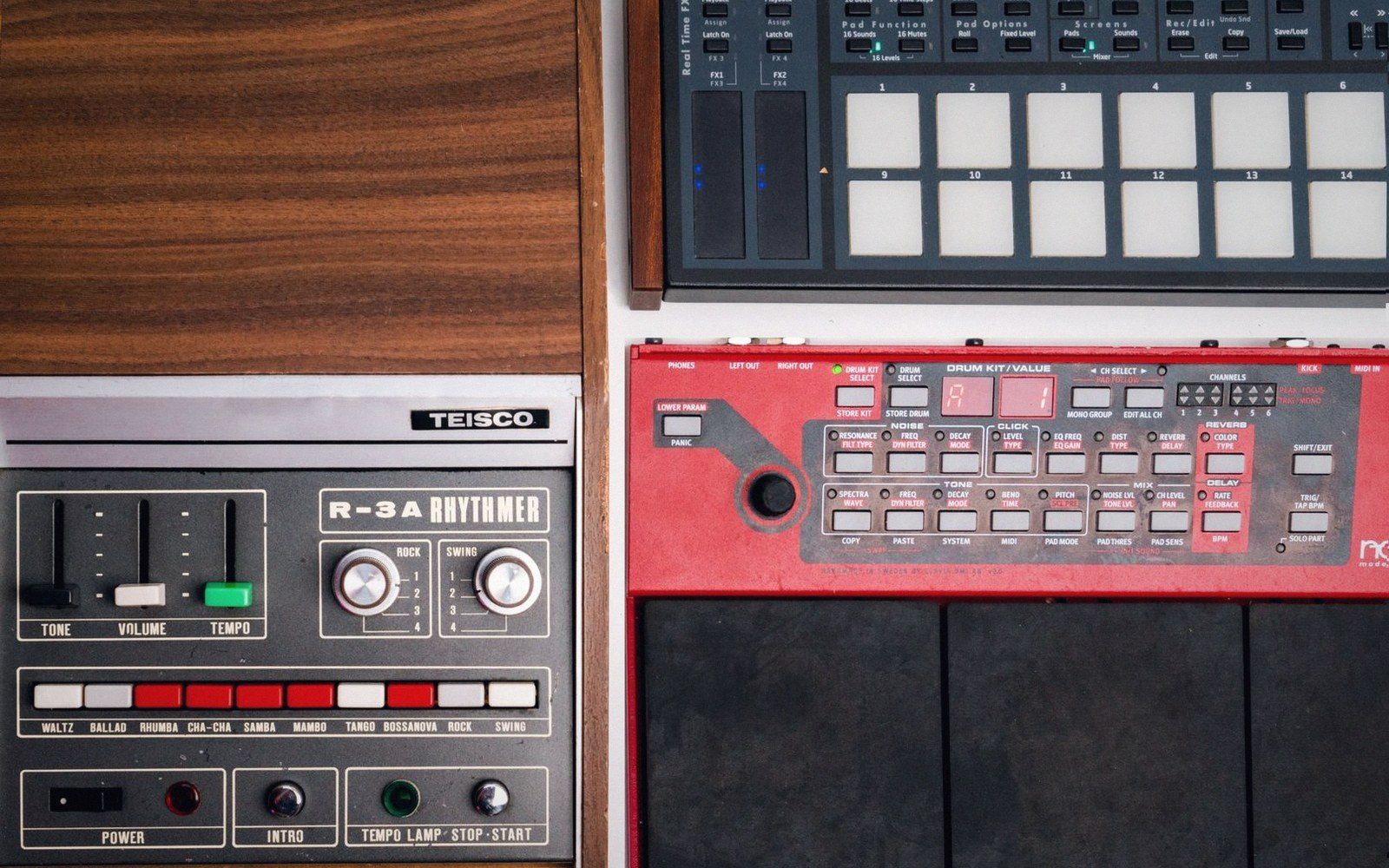
The earliest drum machines gave you buttons or switches to mark beats, and you walked away while they played back. The interface implied an absence — you set the thing going and it ran without you. Roland's TR-808 and TR-909 worked this way. The sixteen-step constraint was architectural, a product of how many stages the shift register held, and the programming model followed: you entered a mode, you marked your hits, you exited. Performance was separate from composition by design.
- Step programmingbeats marked in advance; timing is the machine's; unevenness must be added
- Pad performancetiming is the player's; evenness must be imposed via quantisation after the fact
- The inversion means feel is the default, not the exception
What changed the logic was the assignment of pitch to velocity-sensitive pads arranged in a grid — a surface where each cell could trigger a note, a sample, or a clip, and where how hard you struck it meant something. Akai's MPC60, designed by Roger Linn and released in 1988, was the inflection point. Its sixteen rubber pads were not step buttons in disguise; they were pressure-sensitive strike zones. You could play a pattern into it with your hands, and the machine would record the timing as you actually produced it. The grid became a performance surface.
This mattered for rhythm in a very particular way. Step-programmed drums are mathematically even unless you introduce swing or accent as deliberate parameters — separate, numeric adjustments applied after the fact. A human playing pads does the opposite: the unevenness comes first, baked into the original input, and any quantisation is what happens afterward. The feel is not added; it has to be subtracted if you don't want it. That inversion changed what the instrument was for, and who it was for. Producers who thought in terms of feel rather than grid positions — many of them coming from hip-hop, where the MPC's slightly late-triggering pads produced a specific dragging weight — found a different way in.
The Grid as Spatial Memory
A grid is also a map. Sixteen pads in four rows of four give you a layout you can memorise with your hands rather than your eyes. On the Akai MPC series and its descendants, a bank of sixteen pads could represent a drum kit, a chromatic scale spread across the surface, or sixteen individual samples triggered by position. The spatial logic was consistent enough that players developed genuinely physical knowledge of the layout — muscle memory that let them perform without looking down, the way a pianist learns keys.
This is not trivial. When an interface can be internalised to the point of disappearing, it stops being a menu and starts being an instrument. The constraint of sixteen positions per bank, far from being a limitation, gave the surface a repeatability that abstract software grids never quite replicated. A pad in the lower left corner of an MPC is always in the same place, at the same angle, under the same fingers. That sameness is what performance requires.
When an interface can be internalised to the point of disappearing, it stops being a menu and starts being an instrument.
Later expansions of the concept scaled up the grid rather than abandoning it. Ableton's Push controller, introduced in 2013, used an eight-by-eight matrix of pads to map pitches isomorphically — the same interval relationship in every direction across the surface, so a pattern of finger movements for any given chord shape stays identical regardless of key. This was a different kind of spatial logic from the MPC's kit layout, but it pursued the same underlying goal: making the interface something the body could trust.
The software sequencer running underneath Push is not itself a grid — it is a conventional piano-roll timeline. The grid is the control layer laid on top of it, translating a spatial performance gesture into recorded MIDI data. The interface and the data structure are deliberately different things. What the player experiences is the grid; what the machine stores is a list of note events with timestamps. The gap between those two representations is where the performance actually lives.
- Roland TR-808 / TR-909step-programmed; performance mode absent by design
- Akai MPC60 (1988)Roger Linn's design; velocity-sensitive rubber pads; percentage-based quantisation
- Ableton Push (2013)eight-by-eight isomorphic pad layout; grid as control layer over piano-roll data
What Gets Recorded
When you play a pad grid, you play against a clock. The machine is running — or you have set it running — and your hits land where they land in relation to that pulse. Whether those positions are then snapped to a grid, left exactly as played, or given a weighted nudge toward the nearest subdivision is an editorial decision that follows the performance, not one that precedes it.
This is the structural difference from step programming: the performance exists first, and quantisation is applied selectively afterward, if at all. The choice of how much to quantise — and Roger Linn put this explicitly into the MPC as a percentage control rather than an on/off switch — is a choice about how much of the original human timing to preserve. At zero percent, you keep everything. At a hundred, you are back at step programming with extra steps. The range between those is where the instrument lives.
The pad grid, then, is not an alternative to sequencing — it is a way of feeding the sequencer with time that the body produced rather than time that the machine assumed. The clock still holds the piece together. What changes is who decides what happens inside each bar.