 Photo: Egor Komarov / Pexels
- The ceiling
- One resonant stage decides the whole character
- What imposed it
- Component tolerance — two filters to the same specification do not match
- What it produced
- Cutoff and resonance played as the primary gesture
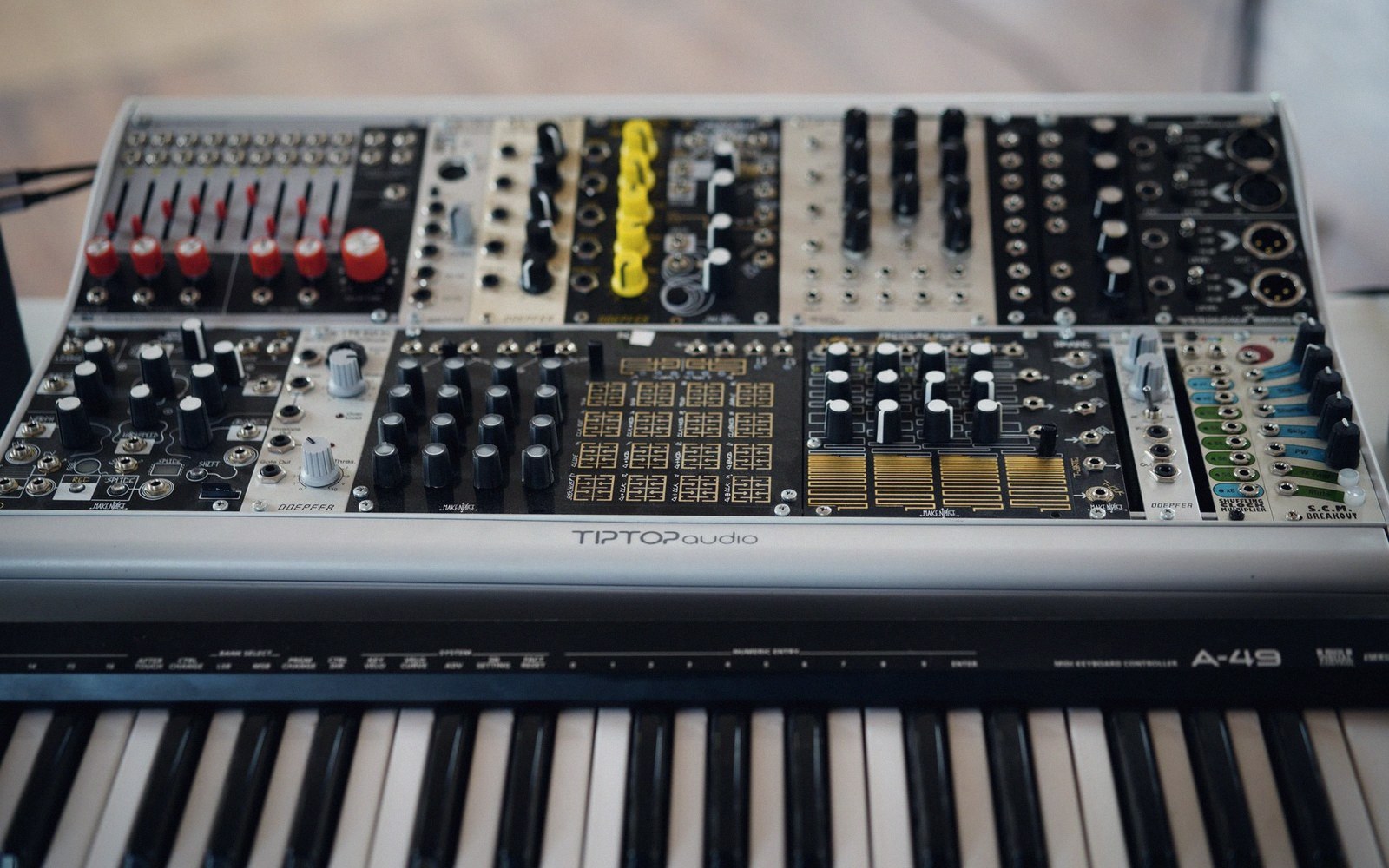
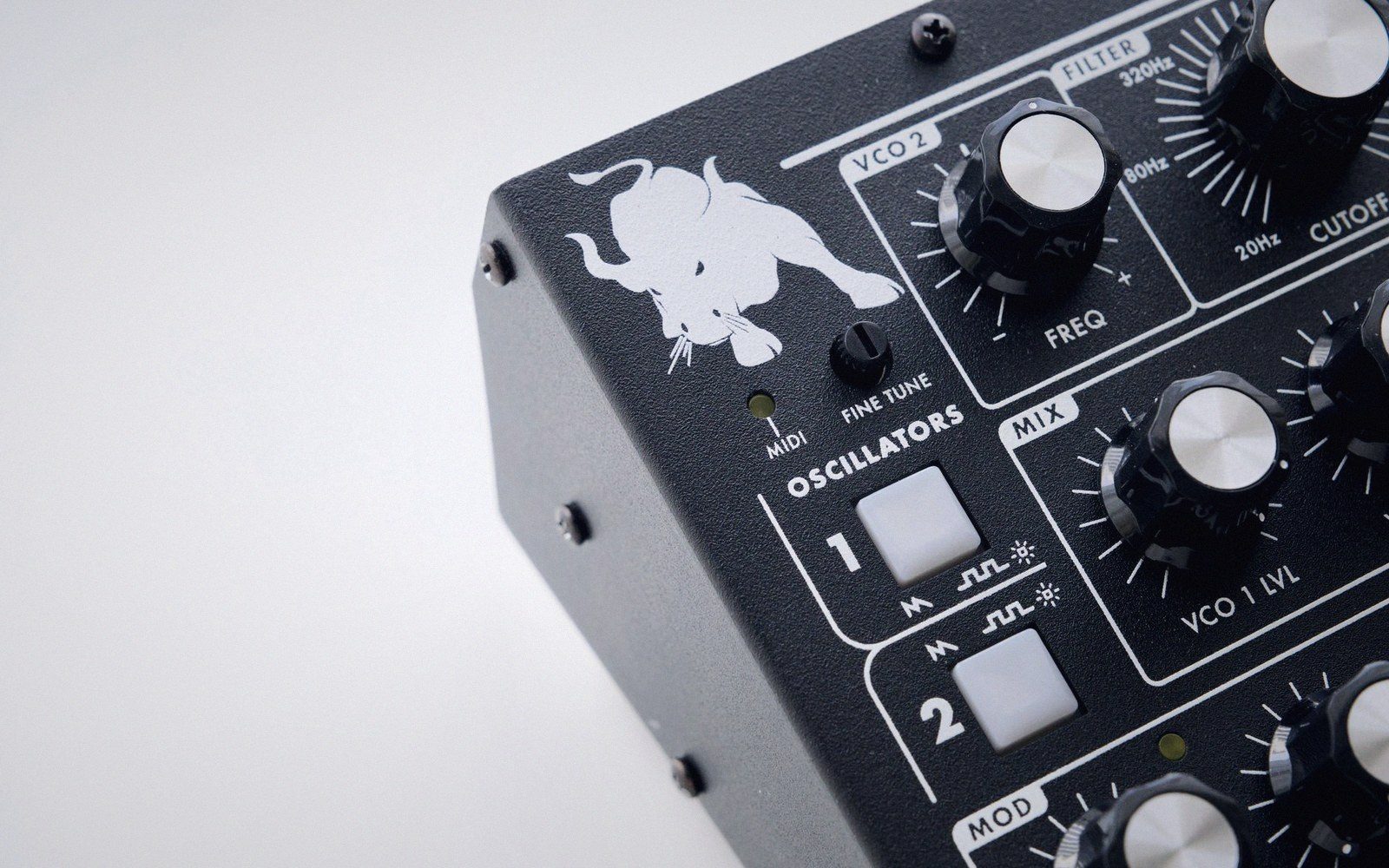
Start with something rich. Add as many harmonics as possible — a sawtooth wave, a square wave, any waveform whose overtone series is dense enough to give you something to work with. Then remove. This is subtractive synthesis: the oscillator sets the raw material, and the filter is where the shaping happens. In practice, the filter is not a supporting component. It is the voice.

The standard architecture is a voltage-controlled low-pass filter — a circuit that passes frequencies below a cutoff point and attenuates those above it. The cutoff moves: turn a knob, or route an envelope, and the filter opens and closes in real time. What you hear is not so much a pitch or a texture as a motion — brightness arriving and then receding, the instrument seeming to breathe. Every analogue lead sound that swells on attack and softens on release is doing exactly this: an envelope generator opening the filter and then letting it fall.
Resonance — also labelled emphasis or Q on different panels — is the filter feeding a proportion of its output back into its own input at the cutoff frequency. The result is a peak in the frequency response right at the cutoff point. Wind up the resonance and the filter begins to ring; push it further and it self-oscillates, producing a pitched sine tone that can be played like a voice of its own. Robert Moog's four-pole ladder filter self-oscillates; so does the Roland IR3109 chip that appeared in the Jupiter-8 and the Juno series. Self-oscillation is not a malfunction — it is the moment the filter stops being a modifier and starts being a source.
- 24 dB/octave — four-pole slope; the Moog ladder filter standard; steep attenuation above cutoff
- 12 dB/octave — two-pole slope; gentler rolloff; found in filters such as the Oberheim SEM and the Korg MS-20
- Resonance at maximumthe point at which many analogue filters enter self-oscillation, producing a sustained pitched sine tone without any oscillator input
Why the same number sounds different
A filter specification — "24 dB per octave slope, low-pass" — describes the rate at which frequencies above the cutoff are attenuated. Twenty-four decibels per octave is four poles of filtering; twelve decibels is two poles. These numbers define the steepness of the curve, nothing more. They say nothing about the character of the circuit, the way it handles transients, whether it warms or colours the signal passing through it, or how the resonance peak actually sounds at high settings.

The Moog ladder filter and the state-variable filter in an Oberheim or an ARP are both analogue, both low-pass capable, and they sound categorically different from each other. The ladder is warm, slightly soft in the high end, and its resonance is musical at extreme settings — part of why the Minimoog became the template for synthesiser bass. The state-variable approach offers more simultaneous filter modes and a sharper, more clinical quality that suited polyphonic ensemble sounds. Neither is more correct. They are different arguments made in transistors.
Component tolerances are part of why two nominally identical synthesisers can sound unlike each other. Capacitor and resistor values drift; transistor characteristics vary across a production batch. Tuning drift in oscillators and filter character variation are both consequences of the same underlying fact: analogue circuits are physical objects, not ideal mathematical functions, and physical objects have opinions. Digital filter models can specify coefficients to many decimal places and will execute them consistently — which is exactly why some digital instruments were designed to model the imprecision of specific analogue circuits, down to the subtle asymmetries that make a particular filter recognisable.
Self-oscillation is not a malfunction — it is the moment the filter stops being a modifier and starts being a source.
What the filter tells you
The filter is the most direct line between a circuit decision and an audible personality. When engineers and players describe a synthesiser's sound — the thickness of a Minimoog bass, the sharpness of an SH-101 lead, the softness of a Juno pad — they are almost always describing the filter. The oscillator establishes the harmonic content; the filter decides which harmonics arrive and when.
- Moog transistor ladderRobert Moog, mid-1960s; the template for subtractive synthesis bass and lead sounds
- ARP / Oberheim state-variablealternative topology offering simultaneous low-pass, high-pass and band-pass outputs; distinct sonic character from the ladder
- Roland IR3109OTA-based chip used in the Jupiter-8 and Juno-6/60/106; musical self-oscillation; warm but slightly thinner than the Moog ladder
This is also why six operators and no filter was so radical a statement: FM synthesis abandons this whole architecture. The timbral control moves into the relationship between operators, into ratios and modulation depth. The filter had been so central for so long that removing it was a design argument about what synthesis even was. To hear the difference is to understand how much work the filter had always been doing.