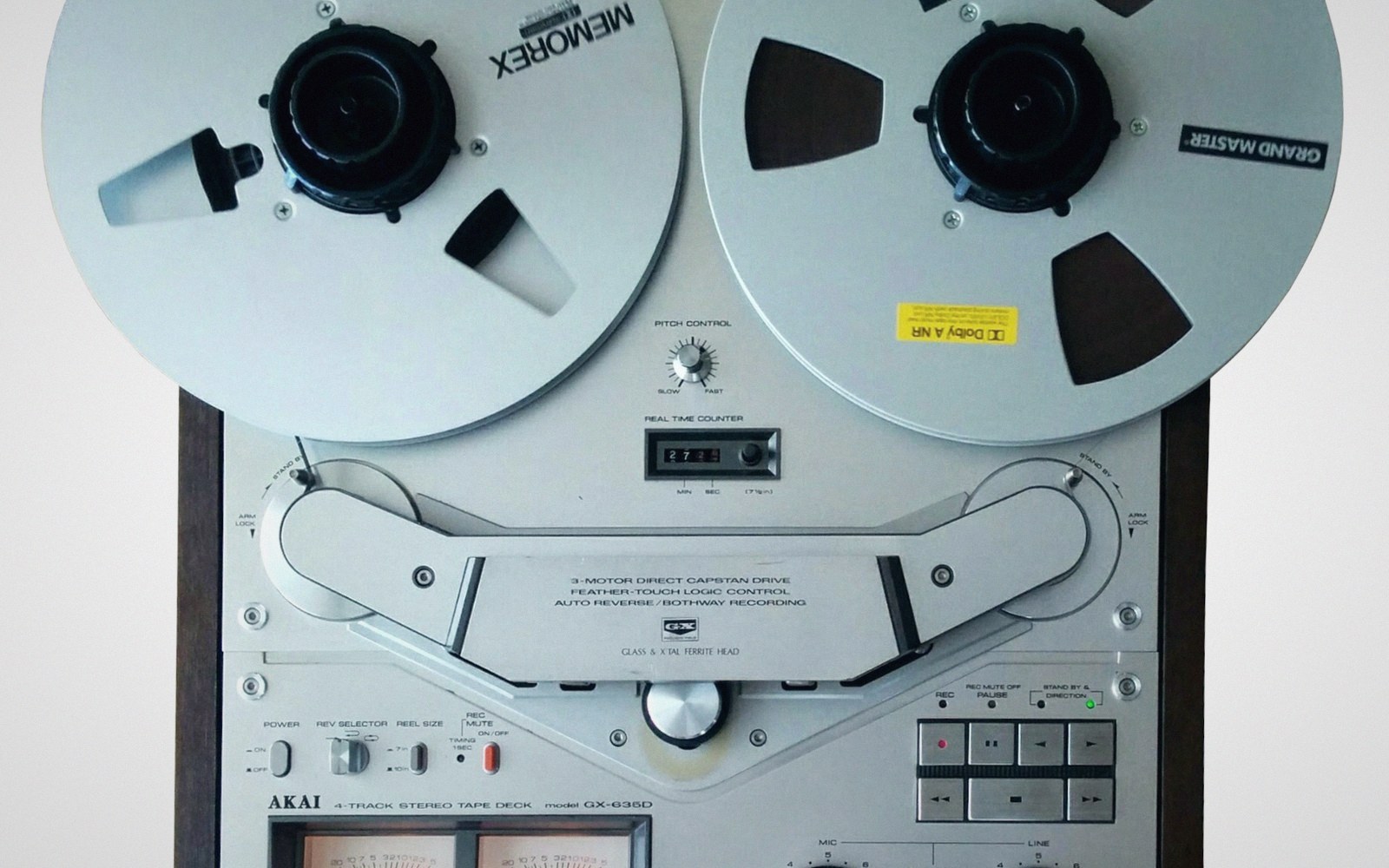
 Photo: Akai GX 635D - edit.jpg · Wikimedia Commons
- The ceiling
- Editing means cutting the only copy
- What imposed it
- Magnetic tape: saturation, wow and flutter, a razor blade
- What it produced
- Arrangement decided with scissors — and a sound now added back
Tape did not record neutrally. From the moment a signal hit the oxide coating on a reel of two-inch, the medium began to make decisions — compressing transients, warming low-mids, rounding high-frequency edges at the point where the magnetic particles could no longer keep up. Engineers learned to drive the tape deliberately into that zone. Running the machine a few decibels hotter than nominal introduced saturation: a soft limiting that glued individual tracks together in a way no piece of outboard equipment fully replicates, because it happened simultaneously across every channel, uniformly shaped by the same physical medium.
The mechanism is straightforward once you know to look for it. Magnetic tape saturates non-linearly — the oxide particles align easily at low signal levels and resist at high ones, so loud transients are squeezed while quieter material passes through relatively unchanged. A snare hit driven hard into tape comes back with its attack slightly blunted and its sustain proportionally louder; the waveform is rounded at its peak. Across a whole mix, this process creates the density listeners associate with analogue recordings — not loudness in the digital sense, but a kind of coherence, everything slightly pushed into the same physical material.
Tape speed mattered too. Slower tape moved less oxide past the playback head per unit of time, which meant less high-frequency resolution. Fifteen inches per second was standard for music; thirty inches per second bought cleaner treble at the cost of half the recording time per reel. The choice was practical and sonic at once. Some engineers dropped to seven and a half deliberately, accepting the top-end softening as part of the sound.
- Saturationnon-linear magnetic particle alignment; loud transients are compressed, quieter material passes more cleanly; the result is density and cohesion across a full mix
- Tape speedmeasured in inches per second (ips); 15 ips and 30 ips were standard for professional music; slower speeds reduce high-frequency resolution, a trade-off some engineers chose deliberately
- Wowslow-cycle speed variation in tape transport; produces gradual pitch drift
- Flutterfast-cycle speed variation; produces rapid, subtle pitch modulation; both are always present to some degree, even on well-maintained machines
Instability as character
Wow and flutter are the names given to periodic speed variations in tape transport — wow for slower cycles, flutter for faster ones. A well-maintained professional machine minimised both, but never eliminated them. The result was a subtle, continuous modulation of pitch and timing: notes breathed slightly, transients arrived with a fractional inconsistency that no two-decimal-point number in a DAW session can quite describe. When that instability is removed — when a recording is cleaned up or transferred frame-accurately — something listeners recognise as warmth is among the first things to go.
The instability was generative too. On a consumer tape deck driven past its design limits, the variations became wide enough to function as a kind of vibrato. Speed changes applied by hand — a thumb on the reel, friction deliberately introduced — became pitch-bend and time-stretch before either concept existed as a button to press.

Editing as composition
The most radical thing tape allowed was physical editing. A razor blade, a splicing block, a roll of quarter-inch leader, and an engineer could cut a two-minute section out of a take, move it four bars earlier, and splice it back in before anyone had thought through the implications for arrangement. The edits were irreversible in the immediate sense — you could tape the piece back together, but you had made a physical mark on a physical object, and the decision carried weight. That weight changed how decisions were made.
In the early decades of the recording studio, tape editing was routinely used not just to fix mistakes but to construct performances that could not have existed in real time. Separate takes of a piano concerto could be cut together bar by bar. Drum sections from different run-throughs of a song could be spliced so that the best sixteen bars of one take preceded the best eight of another. The arrangement was not planned before the session; it was found in the cuts.
This is where the desk as an instrument and tape most clearly converge: both pushed the engineer into a compositional role. The console shaped timbre continuously; the splice shaped time absolutely. Together they made the studio into a place where recordings were not captured but assembled.
- Reel-to-reel tape as primary studio medium: broadly from the late 1940s through the 1990s
- Two-inch, sixteen- and twenty-four-track formats: professional standard through the 1970s and 1980s
- Tape editing with razor blade and splicing block: pre-DAW arrangement technique used on classical, pop and electronic recordings from the 1950s onward
- DAW adoption displacing tape as primary medium: widespread through the 1990s; tape saturation subsequently reconstructed as plug-ins and outboard emulation
The digital audio workstation eventually made all of this easier, faster, non-destructive and, by definition, immaterial. Copy, paste, non-destructive trim, unlimited undo. What it also did was remove the friction. The effort of a splice made editors deliberate. The cost of saturation made engineers listen to what they were committing to. Tape imposed a discipline not through virtue but through physics — and what that discipline produced, when it worked, is still the thing producers reach toward when they talk about a record sounding alive.